Pages

Thursday, August 8, 2013

Books, books, and more books...

I was feeling very overwhelmed looking at my classroom library this year! Ugh! I know you all know the feeling. Last year, my library was organized by guided reading level.  Since my school now has a book room with books categorized by guided reading level, I really wanted my students to be able to choose books by interest and genre this year. I began my search for book bin labels but was highly unsuccessful. Yes, there are so many cute and high quality book bin labels out there, but they all seemed to be made for lower grades.  I just didn't have enough books in those categories.  Most of my books were 4th, 5th, and 6th grade level chapter books.  I decided that I just had to give in and make my own.

Yesterday, I organized all my books by genre so that I could visualize how many books I had in each category. I put post it notes on the baskets as temporary labels, so I knew which labels I had to make. Today, I made the labels! You can get them HERE!


Those are just some examples of the labels.  There are also several other chapter book labels (humor, action/adventure, realistic fiction, etc.) and reference labels. I ordered these fabulous self-adhesive pockets to slide my labels in after I print them.  The labels are 3 x 5 index card size and fit right in these pockets. They should stick on any box or basket!

I'm pretty excited about these and hope some other teachers who teach intermediate grades find them useful also. Students always need to be able to easily access literature!

-h

Wednesday, July 17, 2013

Enhancing Literacy with Online Social Interaction

I did a lot of work this year with integrated social interaction and technology with literacy.  We  know that our students today are intrigued by technology and even more so, socializing through technology.  I decided to try to incorporate the two in order to increase my students' interest in self-selected reading.  My students really took to it and did a great job with their discussions!

I  created five online discussion groups on Edmodo (I posted about edmodo and some of the ways that I use it in my classroom several months ago).  These discussion groups were heterogeneous in order to expose lower students to higher vocabulary and literature.  Heterogeneous grouping can be very beneficial with literature discussion.  I posted a discussion topic each week.  These topics were general so that they could be applied to any book. In my district, we had a weekly reading skill that we focused on; therefore, my discussion questions for their self-selected reading books (on their level) were skills based.  Each student was required to respond to the discussion topic at least once and respond to at least two of their peers' posts.  

This tied in with our curriculum, integrated writing, and improved interest since it involved technology and socializing!  Check out some of my students' posts and responses:


Online literature discussion is a great way to get students excited about reading and integrate writing and technology.  There are other websites that you can use for something like this.  I suggest Edmodo because it is user friendly, manageable, and safe for students. My students absolutely loved this, and I am definitely going to continue it next year!

-h


Friday, May 24, 2013

Role Playing on Edmodo to teach Historical Fiction

Hi, we've decided to venture off with our own blogs! Please go to teachitivity.blogspot.com to find a revised version of this post. See you there. 

I recently had the honor of writing a blog post for Edmodo's blog. I had my students increase their historical fiction reading and writing skills by role playing on Edmodo. They developed historical fiction characters from the Great Depression and created a social networking world that would resemble what Facebook would look like in the 1930s.  It was extremely successful and a great example of how social networking can be effectively used to teach literacy. I would love for you to check out my blog post on Edmodo's Blog and try it out with whatever subject you are teaching. This approach also made it easy for my students to self-assess themselves and for me to differentiate literacy instruction.  See pictures below for more information.

EXAMPLE
This a snapshot of my 5th graders writing unbelievable posts from the perspective of someone living during the Great Depression. They were able to use social networking to show character traits, character relationships, and historical relevance:

GROUPS
Instead of groups, I made families:


BADGES
These are the badges I created. Many of the are just cheesy names that relate to each category from the rubric. The others are badges to encourage strong work ethic skills. The students would meet with me or send me a message when they felt that they deserved a specific badge. They would show me posts to explain why they earn a specific badge. The kids eagerly worked for badges and it ensured me that they were practicing on certain reading and writing skills.

RUBRIC/ASSESSMENT
This is the first page of the rubric my students used to self assess themselves throughout the unit. The rubric includes setting, nonfiction skills, character traits, vocabulary, and technology skills. I used the rubric to guide my mini lessons and strategy groups. Again, the badges helped the students focus on the  reading and writing skills being assessed in this unit.

EXTENSION
Here's how some of my students extended their learning by writing fake newsletters, scrapbooks, or calendars to make their posts more authentic. 


Sunday, May 19, 2013

Todaysmeet: temporary chatroom for students


Hi, we've decided to venture off with our own blogs! Please go to teachitivity.blogspot.com to find my new posts. See you there. 


An amazing friend and teacher introduced me to Todaysmeet a couple months back. It is a temporary chatroom that you can set up in about 5 seconds and schedule it to be deleted in a couple weeks. I used it this year when my students first started learning about historical fiction. After a few lessons on features of historical fiction, students created their own character from the Great Depression time period. The students used Todaysmeet to role-play their character and create a chatroom environment that would resemble the 1930s. I made a self-assessment handout to go along with it. Download it for free here. This was such an easy and fun lesson to do. The kids didn't want to stop!

Elapsed Time with Google Maps

Hi, we've decided to venture off with our own blogs! Please go to teachitivity.blogspot.com to find a revised version of this post. See you there. 

Living in the city, I've realized that I am directionally challenged. Therefore, I love Google Maps. I use it all the time in my personal life and thought, why not use it in the classroom? My students now use it in math to practice elapsed time word problems and are hooked. Surprisingly, my students who take pride in being technologically savvy were unfamiliar with navigating through the app. Who would've thunk it!? I loved that I was able to also incorporate some geography in the math lesson. Killed two birds with one stone. Check it out HERE!!

Weather Channel App in Math

Hi, we've decided to venture off with our own blogs! Please go to teachitivity.blogspot.com to find a revised version of this post. See you there. 

Why not teach kids about temperature using something we use everyday - the Weather Channel app! I'm a huge fan of double dipping whenever I can. This activity brings in geography and statistics while the kids have fun calculating temperatures. The day my kids did this, I tweeted it on our class twitter account and the Weather Channel retweeted us. Of course, I flipped out and took a screenshot of it to show my kids the next day. Find this activity HERE!!
-Katharine

Teaching Food Webs with Facebook

Hi, we've decided to venture off with our own blogs! Please go to teachitivity.blogspot.com to find my new posts. See you there. 
Kids love social networking but often times, it's hard to incorporate it safely in the classroom. I put together this mock-Facebook template for science this year and it turned out to be a blast for the kids. I just used Pages (or Word) and made text boxes. The kids chose an ocean organism from the bottom of the ocean food web and made a "Facebook" profile for them. They showed their understanding of the food web by writing statuses. For instance: "Just had a nice meal of algea, plankton, and bacteria with my family!" Then they might post a status as if an organism higher up on the food chain consumed them today and tagged them on Facebook. It was so easy to differentiate too. Students who needed a challenge either imported images from the internet, staged photographs using photobooth, or created videos using Videolicious. Many of the students included each other's organism in their statuses which made it seem even more authentic. I can't wait to see how else I can use this template next year!
-Katharine

Friday, April 26, 2013

Literature Circle Discussions

I LOVE literature circles! I love to hear the discussions, and I love to hear my students get excited about literature.  I wanted my literature circles to have more rich discussion and to be more structured so that they were on task  and getting things done (every teachers dream...).  I created role cards and discussion guides to make sure that all students were engaged during literature circles.  I also made self-assessments and peer assessments to hold them accountable.  My classroom during literature discussion has truly transformed!


You can find this literature circle packet HERE!

-h

Wednesday, April 24, 2013

Discussion Cube

With Common Core at a forefront in education today and also just an emphasis on higher-level discussion in the classroom, it is important to create an environment where students can learn to back-up and support their thinking.  We do a lot of discussing in my class, but I have been trying to work with my students on keeping the conversation going and having meaningful discussion.  We do sentence starters, and sometimes I even record my kids discussing and let them watch it to focus on what they need to improve on.  A new technique that I have started is this discussion cube.  When the conversation wanes or gets stuck, they just roll the cube and continue with the discussion.  This has helped to show my students how to carry on a discussion, and it has also encouraged some really deep conversations.

This resource is provided HERE!

-h

Wednesday, April 17, 2013

New Items

It has been FOREVER since one of us has posted, but we have been busy little bees teaching teaching teaching! I just wanted to share a couple things that have been going on in my classroom recently.  We are an IB school, so I am always trying to find ways in the classroom to discuss the IB learner profile or promote IB attitudes.  These are basically just good characteristics that we encourage our students to encompass.  I created these fun IB interactive cards for each of my table groups.  After we do an activity or lesson, I have the students pull out the envelope with the cards with it and cooperatively choose an IB attribute of the learner profile that they had to use.  They have to be able to back up their answer because each group chooses one representative to stand and deliver their card.  Then we have a short classroom discussion on their characteristics that they had to demonstrate in order to be a communicator, thinker, risk-taker, etc.  Below is a picture of what some of the cards look like.


These cards with the instructions are located HERE!

Even if you do not work at an IB school, it would be fun to put character words on these cards or words that you want to promote in your classroom.

Wednesday, October 24, 2012

Edmodo and Discussion

Edmodo is obviously a great resource to use in the classroom in many different ways.  I just wanted to share one way that I use Edmodo and how I use it to promote discussion.


Edmodo is a great way for students to discuss their self-selected reading text.  I created small groups with in my class group.  These groups are heterogeneous so that the students can gain information from each other and learn about a variety of different books.  By grouping the student heterogeneously, the students can build off of each other, gain vocabulary, and learn about books that they might not even be capable of reading.

Basically, every week I post a question or a topic for them to discuss about what they are reading.  The students have to post about their book and then respond to two other people's posts within the week.  Not only is this pushing their reading to the extra step, but it is integrated reading and writing.  It is also a great way to promote literature discussion.  Sometimes, I even post something during the week to get them thinking at a higher level if their discussion seems to be surface level.  The students participate in literature circles online through technology!  They love getting to share what they are reading and learning about other good books from fellow classmates.

Just a quick idea!
-h

Tuesday, October 2, 2012

Word clouds in the content areas

Who knew word clouds could have so many uses? Earlier, I posted about using word clouds as an activating strategy. Another way that I use word clouds in my classroom is when learning content area vocabulary. After learning vocabulary words in Social Studies, the students got in groups and made a list of words that describe their designated vocabulary word. Then they created a Wordle using Wordle.net. I printed these off for an activity the next day. At the beginning of the next lesson, I posted the student-made wordles around the room and numbered them. The students then did a silent activity where they walked around the room and wrote down which wordles they thought went with each vocabulary word. We discussed their responses, and I wrote the word on each wordle. I kept these posted until their assessment. This ended up being a great way to review vocabulary in a visual fashion.

-h

Thursday, September 27, 2012

Early Finishers

I have always had the question about what to do with students after they have finished an assignment or test/quiz. This year, I finally feel like I have perfected activities for early finishers.

Below are pictures of my differentiated early finisher chart. There is a pocket labeled with each subject area plus some extra topics. I create assignments or activities for the topic we are studying for each subject area. This is not as hard as it seems because there are a ton of resources on the Internet, and I tend to create general activities like word sorts with vocabulary that can be easily interchanged. I also plan some in depth, application activities for some pockets. The cool thing is that there are always two pockets that you never change. You can add to them if you want but you don't have to switch them out. I will explain those below. The kids know that after they complete something, they are not to be idle. They have to get something out of the early finisher chart. They love it though because they get to choose what they work on and there are TONS of options. Students are always extending their learning which is the best part! Check the pictures out below! Below the pictures are explanations of each pocket.


Reading: Can switch items out for current curriculum.  I always have blank graphic organizers in that pocket for them to fill out.  They can always fill these out for their SSR books or other books they are reading.

Writing:  I have 3 composition notebooks in that pocket.  Each composition notebook has an example test writing prompt on it with the exact instructions that they will see on their state end of the year test.  Students write in the notebooks responding to each prompt.  Then I glue a new prompt on them when most of my students have responded to it.

Social Studies: For each Social Studies unit, I create or find a choice menu for that unit.  There are so many different types of activities that the students can do provided on the menu.  An example is, "Act out something important from the time period that we are studying.  Write a script first, and then have a friend video it with a Flip Camera."

Science:  I have a word sort activity with their vocabulary words from the current unit.  Again, this is interchangeable to each unit.

Math:  I have practice sheets, word problems, and games for the current unit.

Scramble with Students:  This is just some fun with words! They are game sheets like Boggle or Scramble with Friends on the iPhone.  Students are only allowed to complete one a week because they are not specifically content related.  They do make the students think about how words work though and sometimes they are pretty hard.  I have a competition going each week for the student who can get the most points.  These always stay in that pocket.

Choice Menus:  These also always stay in that pocket.  They are very general choice menus having to do with the students weekly affix words or vocabulary or novel choice menus that they can do with any book.  General options can be put in this pocket.

In Progress:  Student work that is in progress goes here.  They are not to leave the classroom without putting it in the In Progress pocket otherwise I will never see it again.

Completed:  Obviously, student completed work goes here.

Hope you find this useful!

-h

Tuesday, September 25, 2012

Dancing Geometry with the Cupid Shuffle

Hi, we've decided to venture off with our own blogs! Please go to teachitivity.blogspot.com to find my new post related to dance. See you there. 

I did this my first year teaching but thought I would share it with everyone. For the kids who beat on tables, sing, and couldn't care less about math, this is the perfect way to teach transformations in geometry.

Part 1: Students trace their footprint on large paper and then recreate their footprint using rotations, reflections, and translations.
Part 2: Introduce the lyrics, song, and the ORIGINAL dance.
Part 3: Students work together to choreograph/create steps and hand gestures to help them remember the vocabulary terms and communicate the dance to others well.

Here's the link to the youtube video of the original Cupid Shuffle. Hit the chorus and the lyrics work PERFECTLY: Original Cupid Shuffle video

Have fun!!!! We had a blast learning geometry this way and my kids still remembered the geometry concepts by the end of the year. This was one of my favorite things I've ever done in the classroom.

-K :)

Thursday, September 20, 2012

Buzzing Readers

Here is another anchor chart I used for one of Lucy Calkins's mini-lessons for reading workshop. As adult readers, we talk about books we love and recommend them to each other all the time. I'm hoping that my students this year will learn to do the same and become fabulous buzzing readers!

We started by interviewing our reading partners and now we are practicing different ways to talk about our books using sentence frames. So far, the kids are pretty excited about it. It's pretty cool to listen in because I think they see themselves as this valuable resource for their reading partner. Buzz away readers!!

-K

Wednesday, September 19, 2012

Transitions

This is a classroom management post.  I am going to try to post more content based blurbs, but I am finding this very helpful in my classroom. 

At the beginning of the year, my students had a very diffiicult time starting the day and ending the day effectively in order to maximize instructional time.  These First 5 and Last 5 posters can help to set up expectations and hold students accountable for those important transition times.  Plus, anybody can alter it to fit your classroom routine and procedures.


Monday, September 17, 2012

Facebook status update

IHi, we've decided to venture off with our own blogs! Please go to teachitivity.blogspot.com to find my new posts. See you there. 

 love Heather's twitter board and decided to do a Facebook status board in my class! My uses are similar to Heather's aside from the IB objectives since we aren't IB here.
Purposes:
- see what lessons made the most impact.
- pre/post assessment
- another avenue to talk about their reading and writing
-to teach word choice and sentence structure
- way to celebrate accomplishments
- inform others of what we are learning in class

My favorite moment was when one of my students shared that her second eraser from her locker went missing or possibly stolen today. Instead of bugging me or others about it, she decided to inform her struggle through her "halebook" status. She felt that the Facebook status was her safest place to express her thoughts because there was a large audience who would read and react to it. Made my day!!

Writing from a List

Hi, we've decided to venture off with our own blogs! Please go to teachitivity.blogspot.com to find my new posts. See you there. 

Writers write from a list to generate ideas or to gather out thoughts. I love Aimee Buckner's book, Notebook Know How. It is the way I launch writing workshop. Here is the anchor chart my students and I created for this particular writing strategy. This is one of my favorites because it can serve multiple purposes. Students love writing lists and the possibilities are endless. I love to also refer to the lists when my students are convinced they have nothing to write about. As they write more lists,it's fun to watch their lists develop and become more specific to them. Yay for lists!!

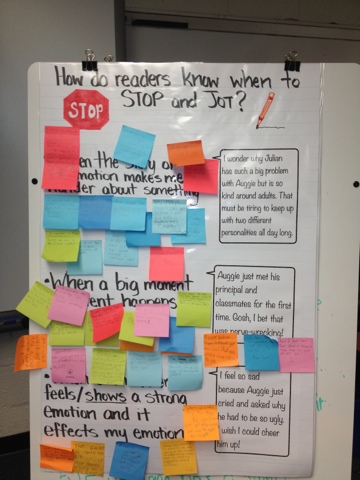
Stop and Jot

Hi, we've decided to venture off with our own blogs! Please go to teachitivity.blogspot.com to find my new posts. See you there. 

Strong Readers "stop and jot" to think and interact with their reading. Here are 5 major moments during reading when readers should stop and jot. We are reading the book, Wonder, during interactive read aloud time and the kids are obsessed with the book. I provided "stop and jot" examples, based on the book, for each situation in order to model what it should look and sound like. To start the year out, my students after each workshop are posting their "stop and jots" under the appropriate type of stop and jot. Hopefully this will become a natural part of their reading.

Sunday, September 16, 2012

Math Centers - 5th grade style!

Hi, we've decided to venture off with our own blogs! Please go to teachitivity.blogspot.com to find my new posts. See you there. 


I've decided that I'm done with whole group learning in math! With students at so many levels, I am doing them an injustice by making them sit there listening to me when they either don't understand or they are bored to death. I know centers aren't a new thing, but while they are highly effective in lower grades, upper grades tend to avoid them. Here is what I'm trying this year and I will post updates/modifications as the year goes on.

Rather than centers, they are called MATH ZONES!! My math zones include the game zone, huddle zone, work out zone, and spin zone. As shown in the photo, I display the 4 zones and the order they go on my pocket chart. The students every morning check to see what color they start with and then rotate in the order of the cards at the top. My math coach suggested I structure it so that the groups are flexible and easy to change every day. She was right, I love doing it this way.

The hard part is timing - We set the timer. My kids say time flies during math zone days!

Schedule (70min period):
Check homework, daily problem, and calendar math (10 min)
Whole group mini lesson/Teaching point (10 min)
Introduce zones (5 min)
Zone Rotations (10 min each/4 rotations)
Link/Homework (5 minutes)

Definition of Zones
Game Zone (picture above): Must be games that require strategy and played usually in pairs.  The games need to push students to apply what they learned and engage in rich conversations that use math vocabulary. Each game lasts 2 days. I model the game and they play for 2 days.

Huddle Zone: My small group instruction time but with a cool name! Instruction for each group is based on the students' needs. The huddle zone controls my groups each day and which groups I want to work with before sending them off to the work out zone.

Work Out Zone: Instead of the gym, we work out by using our brains and hands. Worksheets and manipulatives happen in this zone.

Spin Zone: Spiraling of math standards happens here. I provide a choice of 6-7 math boxes that cover different math strands. The students can pick which ones to do and the order in which they complete them over the week. The trick is to have math boxes that appropriately challenge all levels.